
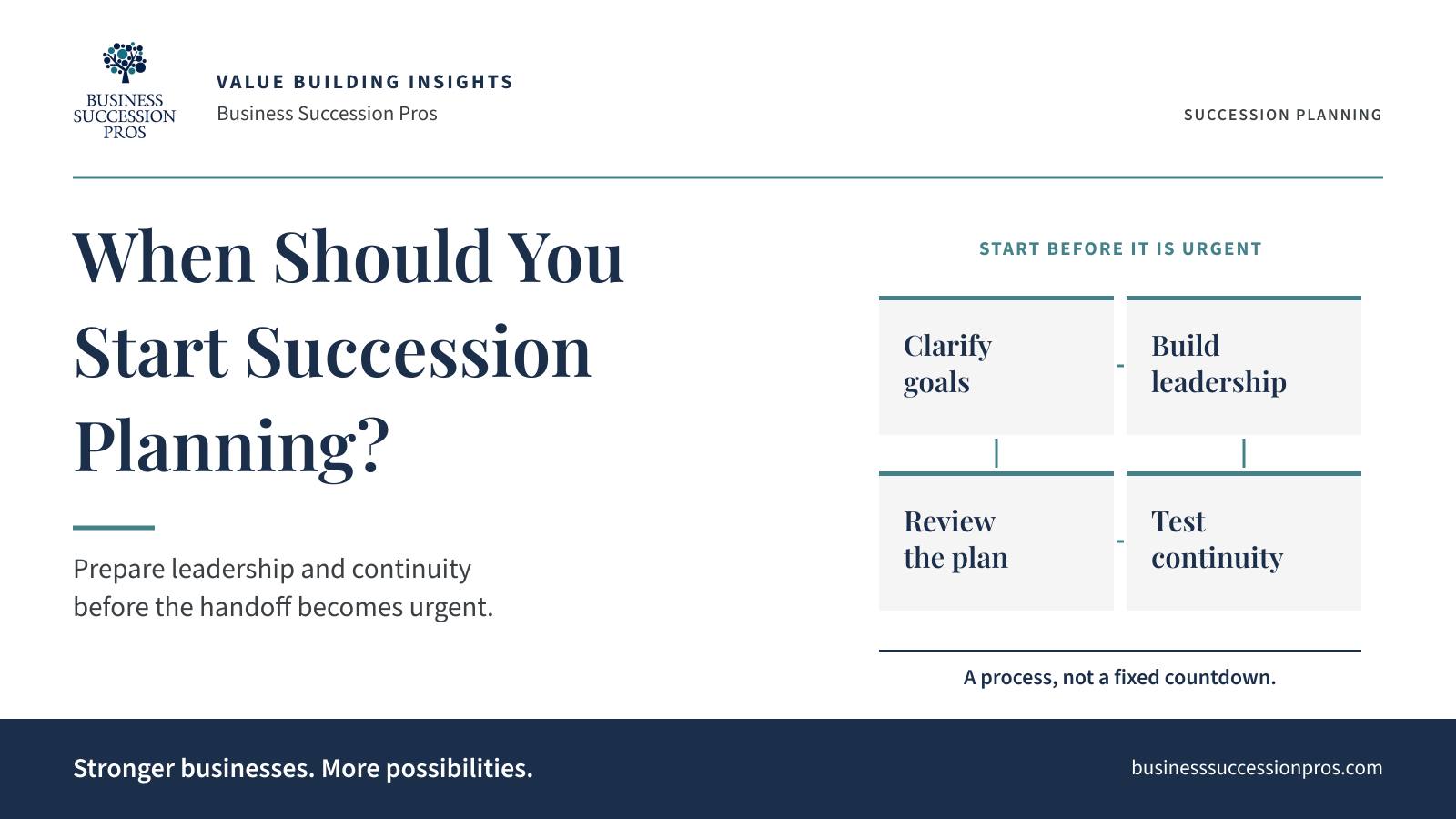
Start succession planning while you still have time to develop people, improve the business and test a handoff. You do not need a retirement date or a chosen successor. You do need to understand what would happen if your role changed.
That preparation can help even if you expect to remain the owner for years. Clear responsibilities, reliable information and capable leaders make the business easier to run today and give you more choices later.
This article focuses on preparing family members or key employees to lead and potentially own the business. An outside sale raises additional buyer and transaction questions, but much of the underlying preparation is shared. The steps below are a starting point to adapt to your circumstances, not a fixed timetable.
1 Describe the future you want
Before deciding who should take over, describe the role you want next. Would you like to leave daily operations, work fewer hours, retain an ownership interest or step away entirely? Which responsibilities would you enjoy keeping, and which are you ready to release?
Write down your preferred timing and your priorities for employees, customers and family. Then separate firm requirements from preferences. You may discover that reducing your workload matters more than transferring ownership immediately.
Start here: Write a one-page description of what a successful change would look like for you and for the business. Mark the questions you cannot yet answer.
2 Find where the business still depends on you
For a week, record the decisions, approvals and problems that reach your desk. Include the relationships you manage and the information only you know. Look beyond your job title to the work that would actually stop if you were unavailable.
Check a few everyday situations. Can someone prepare an accurate estimate, resolve a customer complaint, approve routine spending and explain the monthly results without waiting for you? If not, determine whether the gap is knowledge, authority, information or capacity. Each calls for a different response.
Start here: Choose one recurring dependency that creates delays. Define what another person would need to handle it reliably.
3 Discuss interest before assuming a successor
A family member may care deeply about the company without wanting to lead it. A strong employee may want greater responsibility without wanting to buy an ownership stake. Neither conversation should be settled by assumptions.
Describe the future role before choosing the person. What decisions will the leader make? Which capabilities will matter most? What support will be available? Discuss interest, expectations and development needs privately and directly with potential successors.
Keep promises about ownership separate from exploratory conversations. If no suitable successor is interested, that is useful information. You can continue developing the team while considering other options.
4 Develop leadership through real decisions
Training alone will not show whether someone can lead. Give a potential successor meaningful responsibility, access to relevant information and clear boundaries for decisions. Agree on when you need to be consulted and when the decision is theirs.
For example, an operations manager might take responsibility for routine service recovery within agreed spending limits. Review the outcomes together: Were customers followed up with? Were commitments met? Did the manager recognize when escalation was necessary?
Increase responsibility as the evidence supports it. If you routinely reverse decisions or step in before the person has a chance to act, you will learn little about their readiness. BDC’s transition guidance similarly emphasizes developing managers who can make decisions without the owner.
5 Separate leadership from ownership and money
Being ready to run a company is different from being ready to own it. A capable successor may need time to understand the financial commitment, explore funding and decide whether ownership fits their goals. You also need to understand how a proposed transition would affect your own financial position.
Discuss business value and your personal financial needs with qualified advisors. Have legal and tax professionals help evaluate the ownership arrangements under consideration. Do not assume that a leadership promotion, informal family agreement or hoped-for purchase price resolves those questions.
Start here: Make two lists, one for leadership responsibilities and one for ownership decisions. Identify who needs to participate in each discussion and what information is missing.
6 Turn the plan into work you can test
Choose a few preparation priorities rather than trying to change everything at once. Give each an accountable person, a next action, a review date and a way to judge progress.
Useful evidence includes decisions made within agreed limits, financial reports the next leader can explain, customer relationships supported by more than one person and documented processes that employees actually use. A completed training session or written procedure is only a starting point; check what changes in day-to-day work.
Review progress with the people involved. Adjust responsibilities, training and timing when results expose a gap. A transition date should reflect readiness and your circumstances, not replace the work required to get there.
7 Prepare for an absence before the transition is ready
A gradual succession plan does not answer every question about an unexpected absence. Identify who would lead temporarily, how essential information could be accessed securely and which decisions require formal authority. Have your advisors review the arrangements rather than relying on verbal understandings.
This work protects continuity while the longer-term plan develops. It also reveals gaps that may be affecting the business already.
What to do in your first month
- Describe your preferred future role and the questions still open.
- Record the work and relationships that depend on you.
- Begin a conversation with a potential successor, or define the capabilities you need to develop.
- Transfer one suitable responsibility with clear limits, support and a review date.
You do not need to announce a transition to begin. Start with one change that makes the business less dependent on you, then use what you learn to choose the next.
Frequently asked questions
How far ahead should I start
Early enough to develop people and test changes before you need to rely on them. There is no timetable that fits every company. If your desired transition is close, identify the decisions that cannot wait and be realistic about gaps that need longer to address.
What if I decide to keep the business
The preparation can still be useful. Stronger leadership, clear authority and reliable operations support continued ownership as well as a future succession or sale.
If you would like help identifying where to begin, a free, 30-minute Clarity Call with BSP is available.
This article provides general education, not individualized legal, tax or financial advice.